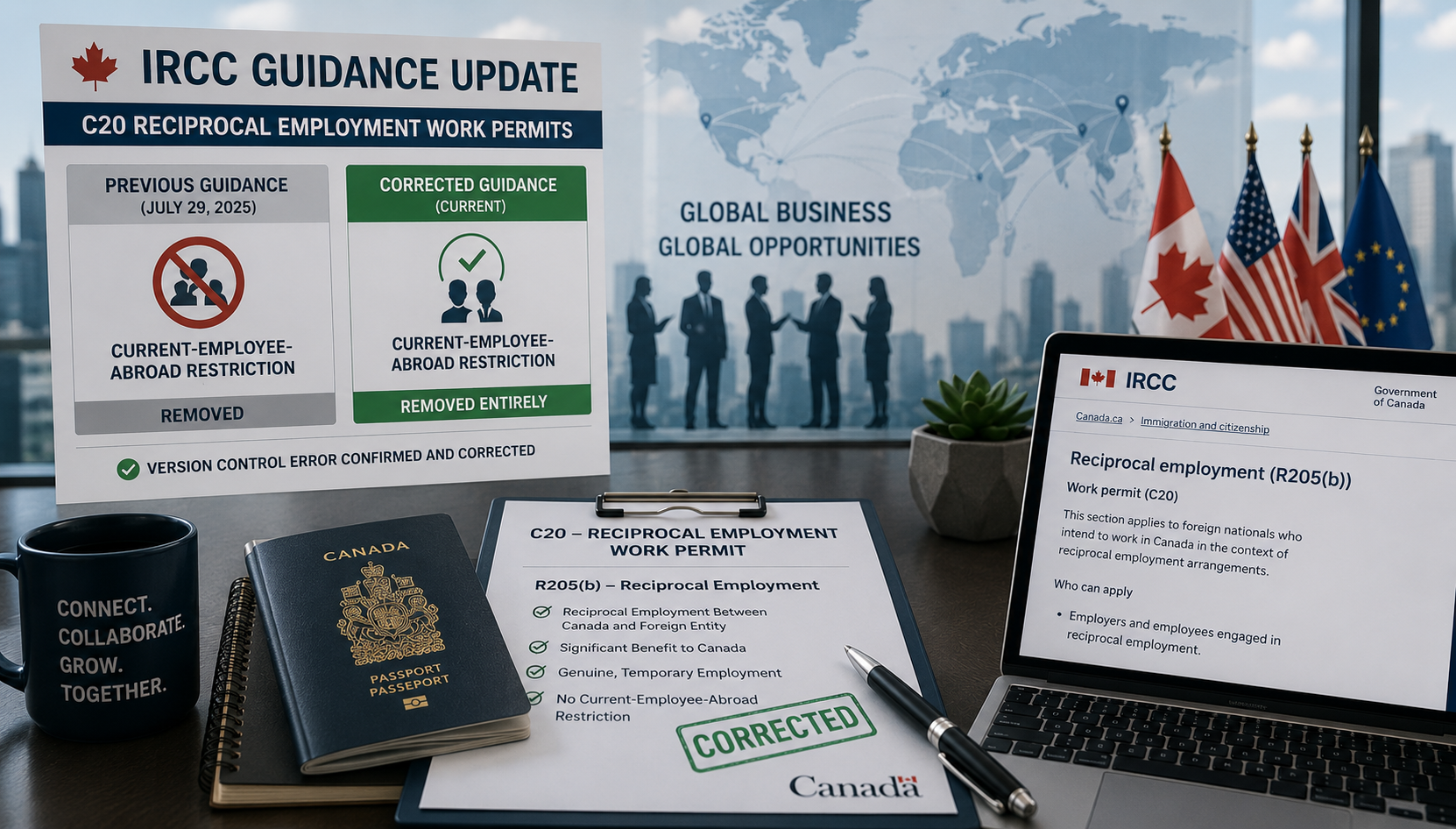
On July 29, 2026, IRCC published updated guidance for officers processing work permits under the Reciprocal Employment category, R205(b) – C20, an LMIA-exempt category most often used by multinational companies, academic institutions, and non-profits. That update included a new restriction limiting eligibility to foreign nationals already employed by the company abroad.
That restriction turned out to be a mistake. IRCC confirmed the July 29 posting was published in error due to a version control issue and did not reflect the department’s intended policy. On August 6, 2026, IRCC issued a corrected version of the guidance, removing the current-employee restriction entirely.
What this means:
- The current-employee requirement is gone. Applicants are no longer required to already hold a job with the company abroad before applying under C20.
- The underlying category is unchanged. R205(b) still allows a foreign national to work in Canada without an LMIA when doing so creates or maintains reciprocal employment opportunities abroad for Canadians or Canadian permanent residents.
- Reciprocity still doesn’t need to be strictly bilateral. Multinational companies can demonstrate reciprocity across their own international offices rather than needing a formal country-to-country arrangement.
This is a useful reminder that IRCC’s own published guidance can shift quickly, sometimes within days, and applicants and employers relying on a specific policy detail should confirm it’s still current before submitting an application.
FAQs
Do C20 applicants still need to already be employed by the company abroad?
No. That requirement was removed on August 6, 2026, after IRCC confirmed it had been published in error.
Does C20 require a formal government-to-government agreement?
No. Multinational companies can rely on reciprocity across their own international offices without a formal bilateral treaty.
Why did IRCC change the guidance so quickly?
IRCC stated the July 29 version was posted due to a version control issue and did not reflect the department’s intended policy.
Is C20 the same as a CUSMA or intra-company transfer work permit?
No, it’s a separate LMIA exemption category, though it can serve a similar purpose for multinational employers.
Should I double-check current IRCC guidance before applying under C20?
Yes. Given how recently this guidance changed, it’s worth confirming the current version of the instructions before submitting an application.
Reach out to our team at info@visaserve.ca or call 905-203-2266 to speak with an experienced Canadian immigration lawyer today.