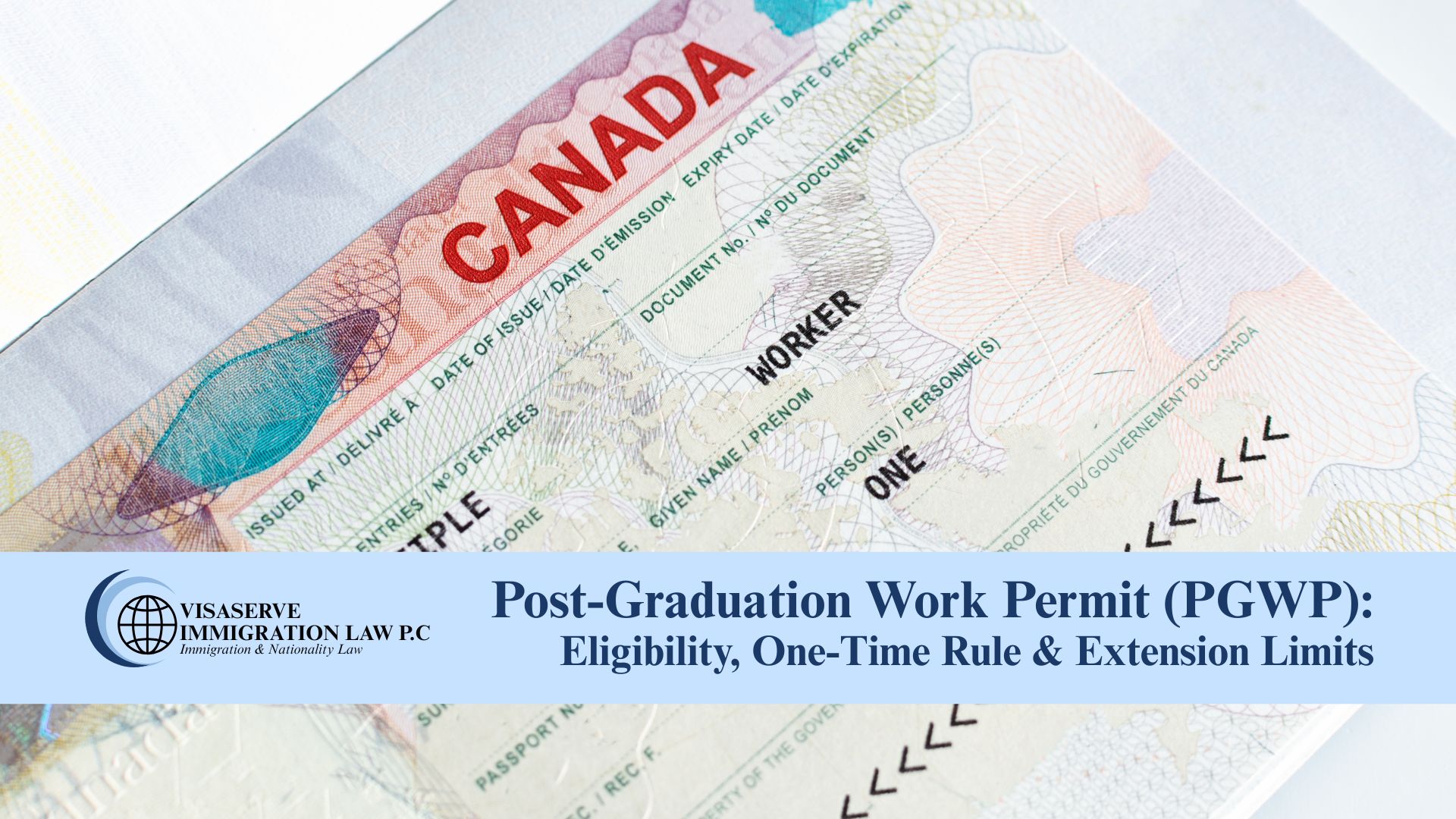
Canada’s Post-Graduation Work Permit (PGWP) remains one of the most important transition pathways for international students who wish to gain Canadian work experience after completing their studies. However, strict eligibility criteria, the one-time issuance rule, and limited extension options often create confusion.
The PGWP program is administered by Immigration, Refugees and Citizenship Canada (IRCC) under the International Mobility Program.
This guide explains who qualifies, how the one-time rule works, and when (if ever) a PGWP may be extended.
What Is a Post-Graduation Work Permit (PGWP)?
A PGWP allows eligible international graduates to work in Canada after completing a qualifying academic program.
It is an open work permit, meaning the holder may work:
-
For most employers,
-
In most occupations,
-
Without a Labour Market Impact Assessment (LMIA).
Canadian work experience gained under a PGWP may later support applications through:
-
Express Entry (including Canadian Experience Class),
-
Provincial Nominee Programs (PNPs),
-
Employer-supported permanent residence pathways.
For many students, the PGWP serves as a bridge between study and permanent residence.
Language Requirements for PGWP Applications
Recent regulatory updates require most PGWP applicants to submit proof of language ability at the time of application.
This requirement applies even if language testing was previously submitted for a study permit.
Failure to provide valid language test results can result in:
-
Processing delays,
-
Requests for additional documents,
-
Refusal of the application.
Applicants should confirm current testing requirements and validity periods before submission.
Who Is Eligible for a PGWP?
To qualify, applicants must generally:
-
Graduate from an eligible Designated Learning Institution (DLI),
-
Complete a program that meets PGWP duration requirements,
-
Maintain full-time student status (with limited exceptions),
-
Apply within the prescribed timeframe after receiving confirmation of program completion.
Not all programs qualify — even if the institution itself is a DLI. Verifying eligibility before graduation is critical.
The One-Time PGWP Rule
IRCC allows only one PGWP per lifetime.
For example:
-
If you complete a bachelor’s degree and receive a PGWP, you cannot receive another PGWP after completing a master’s degree later.
-
Studying again in Canada does not reset PGWP eligibility.
This rule is strict and frequently misunderstood. Strategic planning before the first PGWP application is essential.
Can a PGWP Be Extended?
In most situations, PGWPs cannot be extended.
The primary exception applies when:
-
The PGWP was issued for a shorter duration solely because the applicant’s passport expired before the full eligible period.
In such cases:
-
IRCC may issue a shortened PGWP,
-
The approval notice often confirms eligibility to apply for an extension after passport renewal,
-
The extension is limited to the remaining eligible duration only.
Outside this narrow scenario, PGWP extensions are generally unavailable.
Why Passport Validity Is Critical
Many graduates unintentionally lose work authorization time because their passport expires too soon.
Before applying for a PGWP, students should:
-
Confirm passport validity covers the full potential PGWP duration,
-
Renew the passport in advance if necessary.
This step alone can prevent significant loss of authorized work time.
Designated Learning Institutions (DLIs): Confirming Eligibility
Only graduates from eligible DLIs may qualify for a PGWP.
Students must confirm:
-
The institution appears on IRCC’s official DLI list,
-
The specific program is PGWP-eligible,
-
The program length meets PGWP issuance criteria.
Graduating from a non-eligible program may eliminate PGWP eligibility entirely.
PGWP vs. Other Canadian Work Permit Options
| Category | PGWP | Employer-Specific Work Permit |
|---|---|---|
| Who Qualifies | Eligible international graduates | Workers with Canadian job offer |
| Employer Required | No | Yes |
| LMIA Required | No | Often required |
| Permit Type | Open | Closed |
| Number of Times Issued | Once per lifetime | May be renewed |
| Extension Possible | Rare (passport-related only) | Often possible |
| Best For | Initial Canadian work experience | Long-term employer relationship |
Understanding these distinctions helps graduates plan long-term immigration strategy.
Common PGWP Mistakes to Avoid
Students frequently encounter problems due to:
-
Assuming PGWP eligibility resets after further study,
-
Applying with a soon-to-expire passport,
-
Failing to meet language requirements,
-
Graduating from a non-eligible program,
-
Missing application deadlines.
Many of these issues are preventable with early planning.
Frequently Asked Questions
Can I apply for a PGWP more than once?
No. IRCC permits only one PGWP per lifetime.
Does completing a second degree make me eligible again?
No. Additional studies do not reset PGWP eligibility.
Can I extend my PGWP before it expires?
Generally no, unless it was shortened due to passport validity.
Is the PGWP an open work permit?
Yes. It allows work for most employers in Canada.
Do I need language test results?
Yes. Most applicants must provide valid language test results at the time of application.
What if my program is not PGWP-eligible?
You may not qualify for a PGWP, but other work permit options may be explored depending on your circumstances.
How Visaserve Immigration Law P.C. Can Assist
At Visaserve Immigration Law P.C., we assist international students with:
-
Confirming PGWP eligibility before graduation,
-
Reviewing passport validity and timing considerations,
-
Assessing language compliance requirements,
-
Advising on alternative work permit options,
-
Planning long-term permanent residence strategies.
Early legal review can protect future immigration options.
Final Takeaway
The Post-Graduation Work Permit is a valuable opportunity for international students seeking Canadian work experience. However, it is generally issued only once, is rarely extendable, and requires strict compliance with eligibility requirements.
Understanding these rules before applying helps international graduates safeguard their long-term immigration goals.