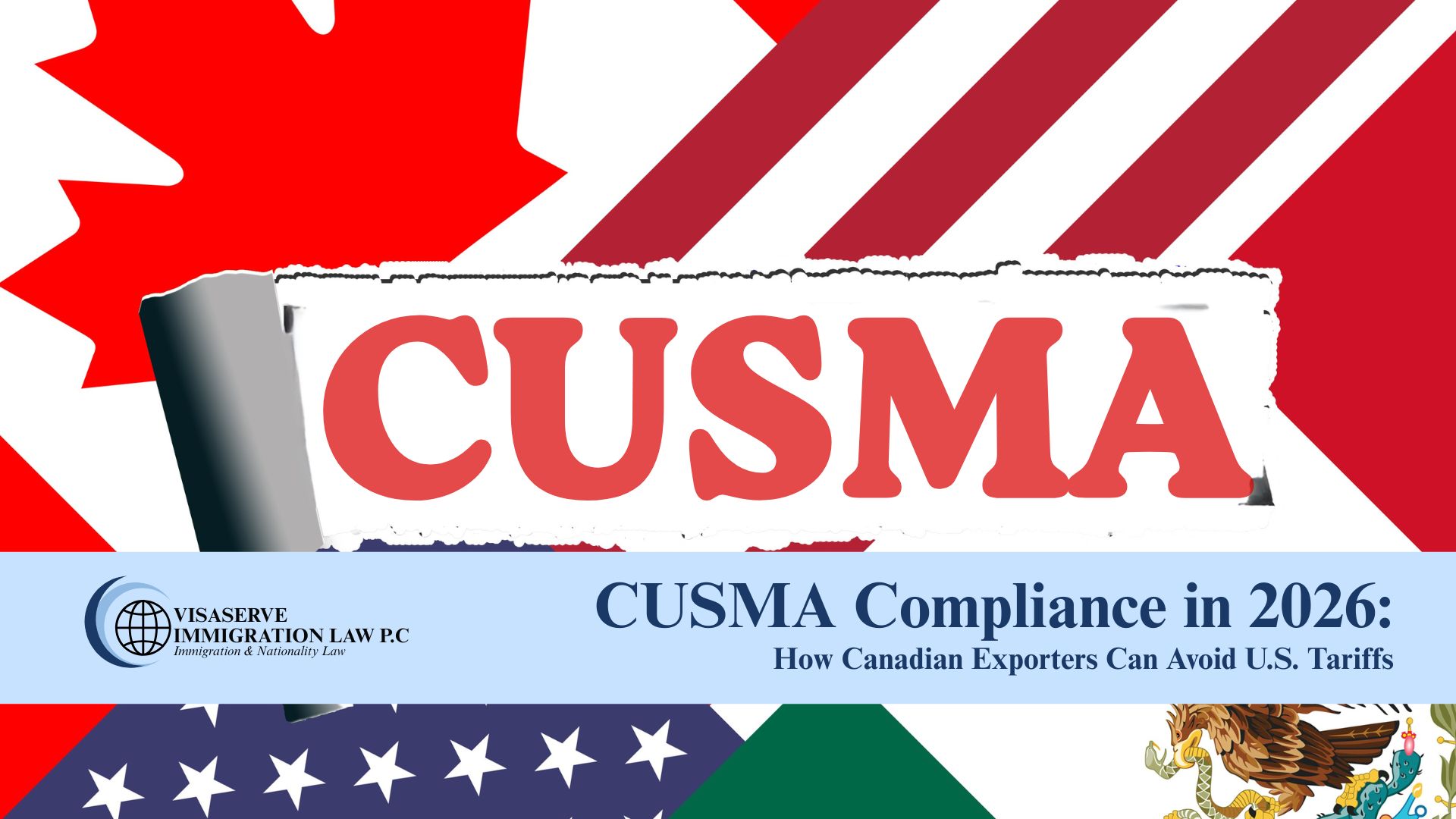
As trade tensions and tariff enforcement continue to reshape cross-border commerce in 2026, Canadian businesses exporting to the United States are increasingly searching for one solution: CUSMA compliance. (Source)
For many exporters, understanding whether their products qualify under the Canada-United States-Mexico Agreement may now determine whether they remain competitive in the U.S. market.
According to the Government of Canada, more than 98% of tariff lines and over 99.9% of bilateral trade between Canada and the United States can potentially benefit from preferential treatment under CUSMA if the goods meet the agreement’s rules of origin.
However, many businesses mistakenly assume that simply manufacturing goods in Canada automatically makes them CUSMA compliant. In reality, compliance requires careful review of sourcing, production methods, tariff classifications, and documentation.
What Is CUSMA Compliance?
CUSMA compliance refers to ensuring that goods exported between Canada, the United States, and Mexico satisfy the agreement’s rules of origin and qualify for preferential tariff treatment.
Under current U.S. tariff measures, this has become increasingly important. The Government of Canada notes that goods qualifying under CUSMA remain exempt from certain U.S. tariffs imposed under the International Emergency Economic Powers Act (IEEPA) and Section 122 tariffs introduced in 2025.
To qualify for preferential treatment, businesses must demonstrate that their products are considered “originating” under the agreement.
Why CUSMA Compliance Matters More in 2026
Prior to recent tariff actions, many Canadian exporters did not actively claim preferential treatment under CUSMA because duties were already low or nonexistent.
That environment has changed significantly.
Today, products that do not qualify under CUSMA may face additional tariffs when entering the United States. For businesses operating on tight margins, these costs can substantially affect pricing, competitiveness, and long-term contracts.
Canadian exporters in manufacturing, automotive, food processing, industrial production, consumer goods, and technology sectors are now reassessing their supply chains to determine whether they meet CUSMA requirements.
How Goods Qualify Under CUSMA
CUSMA uses detailed rules of origin to determine whether a product qualifies for preferential tariff treatment.
These rules generally fall into three categories:
1. Tariff Classification Change
A product may qualify if imported materials undergo sufficient transformation during manufacturing in North America.
For example, imported raw wood transformed into finished furniture in Canada may satisfy this requirement depending on the applicable Harmonized System (HS) classification.
2. Regional Value Content
Some goods must contain a minimum percentage of North American value or content.
This is especially important in industries such as automotive manufacturing, electronics, and industrial equipment.
3. Specific Production Processes
Certain industries require production activities to occur within North America.
For instance, some textile products must be cut and sewn in North America to qualify under CUSMA.
Certification of Origin Is Mandatory
One of the most overlooked aspects of CUSMA compliance is documentation.
Even if a product technically meets the rules of origin, tariff benefits are not automatically granted.
The importer must make a formal claim for preferential treatment supported by a valid Certification of Origin completed by the exporter, producer, or importer. Goods lacking proper certification are treated as non-originating and may become subject to tariffs.
Businesses should also understand that record-keeping obligations apply under Chapter 5 of the agreement.
Products That May Not Fully Qualify
Some products remain subject to special restrictions despite meeting origin requirements.
The United States maintains tariff-rate quotas (TRQs) on certain dairy, sugar, and sugar-containing products under CUSMA. Only imports falling within these quota limits may receive preferential tariff treatment.
Additionally, certain sectoral tariffs imposed under Section 232 continue to apply to categories such as:
- Steel
- Aluminum
- Copper
- Autos
- Trucks
- Certain wood products
- Certain semiconductors
These products may still face tariffs even if they are otherwise CUSMA compliant.
What Businesses Should Do Now
Canadian businesses exporting to the U.S. should consider conducting a proactive CUSMA compliance review that includes:
- Verifying HS tariff classifications
- Reviewing product-specific rules of origin
- Assessing North American content thresholds
- Reviewing supplier sourcing strategies
- Preparing compliant certifications of origin
- Maintaining supporting documentation
- Consulting customs brokers or trade professionals
The Government of Canada also encourages businesses to seek advance rulings from U.S. Customs and Border Protection where classification or treatment remains uncertain.
Final Thoughts
CUSMA compliance is no longer simply a trade optimization strategy. For many Canadian exporters, it has become a critical risk-management issue.
As tariff enforcement intensifies and cross-border trade becomes more scrutinized, businesses that fail to properly structure and document their exports may face avoidable costs, shipment delays, or denied preferential treatment.
Understanding whether your goods qualify under CUSMA and ensuring proper compliance procedures are in place can help protect your access to the U.S. market in 2026 and beyond.
For businesses navigating complex North American trade rules, legal and compliance guidance can play an important role in minimizing risk and maintaining operational stability.
Reach out to our team at info@visaserve.ca or call 905-203-2266 to speak with an experienced Canadian immigration lawyer today.