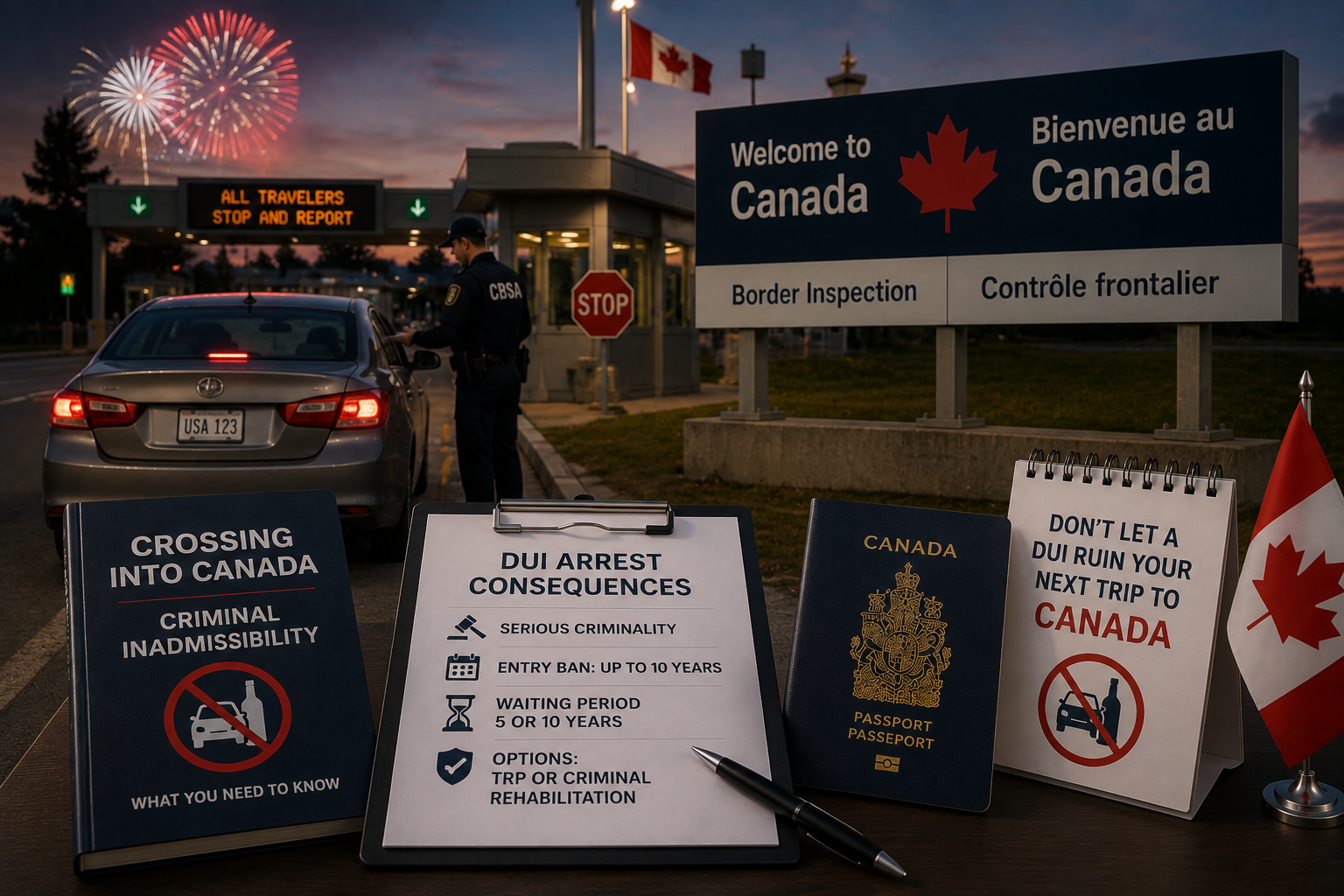
Independence Day weekend brings a predictable spike in DUI arrests across the U.S., and for anyone with travel plans to Canada, a holiday mistake can carry consequences well beyond the courtroom. Under Canadian immigration law, a DUI isn’t treated as a minor traffic issue. It’s classified as serious criminality, and it can keep you out of Canada for years if it isn’t handled properly.
The reason comes down to a change Canada made to its impaired driving laws back in December 2018. Before then, DUI was treated as an ordinary offense. Since that change, the maximum potential sentence for impaired driving under Canadian law jumped to 10 years, which automatically pushes any DUI committed after that date into the “serious criminality” category under the Immigration and Refugee Protection Act. That single classification shift is why a routine DUI charge from this past weekend could follow someone to the Canadian border.
If your case is still pending, you’re not automatically banned, but you’re not in the clear either. Canada Border Services Agency officers can see pending charges through shared criminal databases, and they generally treat an unresolved charge as reason enough to deny entry until you can show a certified final outcome from the court.
Once a DUI results in a conviction, the timeline for getting back into Canada depends entirely on how you handle it. A Temporary Resident Permit can allow entry sooner, sometimes even before five years have passed, but it’s discretionary and requires a genuinely compelling reason to travel, not a vacation or casual visit. After five years from the date every part of the sentence is fully served, including fines, probation, and license suspension, applying for Criminal Rehabilitation becomes an option, offering a permanent fix rather than a one-trip waiver. One thing that catches a lot of people off guard: the old rule where 10 years automatically cleared an inadmissibility no longer applies to DUIs committed after 2018. Formal Criminal Rehabilitation is now required regardless of how much time has passed.
If your attorney negotiates the charge down to something like reckless driving, don’t assume that resolves the Canadian side of things. CBSA officers look at the underlying conduct, not just the final charge, so a lesser plea can still trigger the same inadmissibility. A Legal Opinion Letter from a Canadian immigration lawyer, comparing the exact statute to Canadian law, is often the only way to clear that up before you travel.
For a broader look at how Temporary Resident Permits and Criminal Rehabilitation work for any type of criminal record, not just DUI, see our related post on entering Canada with a criminal record.
FAQs
Does a pending DUI charge stop me from entering Canada?
It can. Border officers often treat an unresolved charge as grounds for refusal until you provide proof of a final court outcome.
Why does a DUI count as “serious criminality” in Canada?
Because of a 2018 change to Canadian law that raised the maximum sentence for impaired driving to 10 years.
Can I still enter Canada if my DUI charge gets reduced to reckless driving?
Not automatically. Officers assess the underlying facts of the case, and a Legal Opinion Letter is often needed to resolve the issue.
How soon can I apply for Criminal Rehabilitation after a DUI conviction?
Five years after every part of your sentence, including fines, probation, and license suspension, has been fully completed.
Does the old 10-year automatic rule still apply to DUIs?
No. That rule only applied to offenses before the December 2018 law change. Post-2018 DUIs require a formal Criminal Rehabilitation application.
Reach out to our team at info@visaserve.ca or call 905-203-2266 to speak with an experienced Canadian immigration lawyer today.