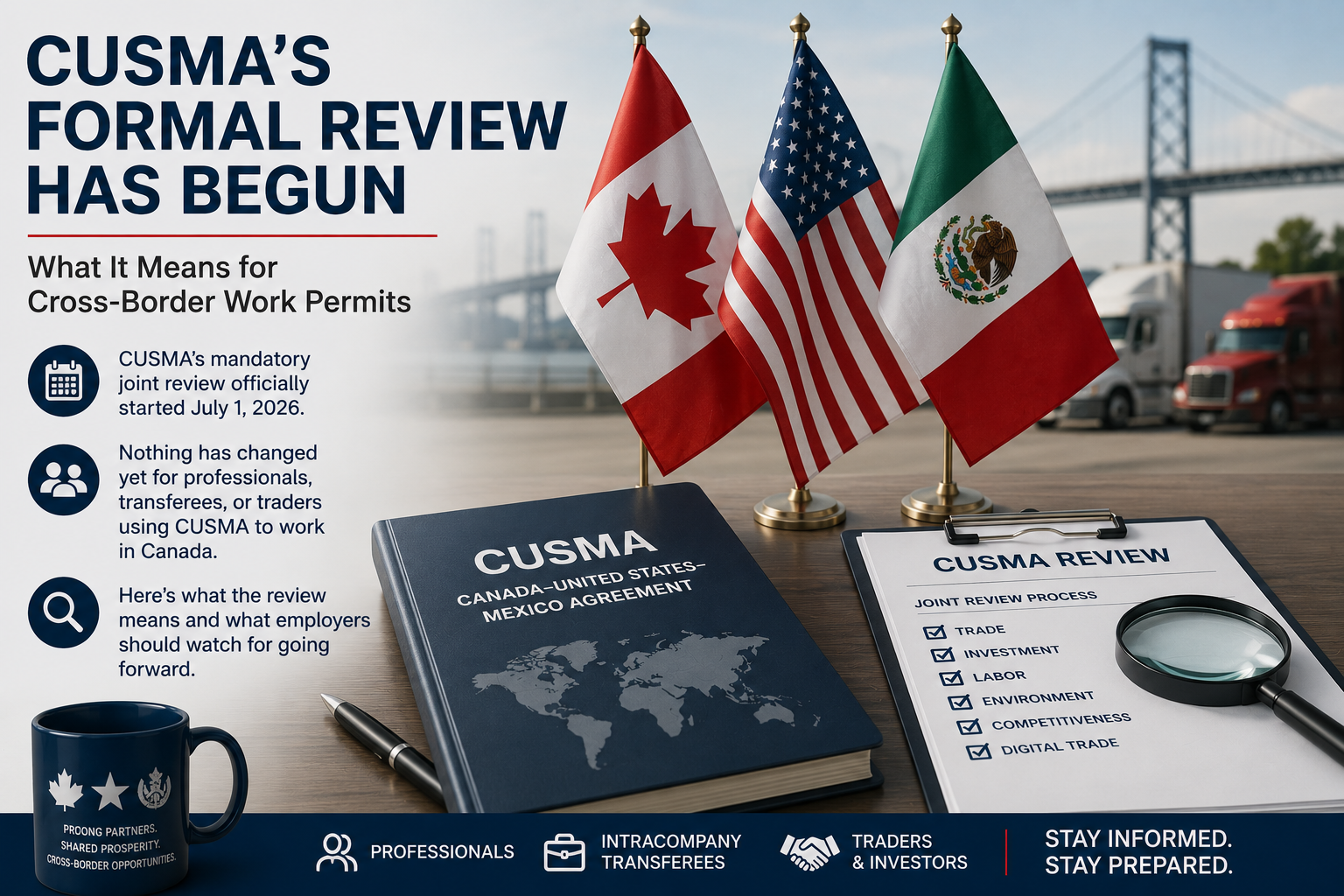
CUSMA didn’t expire this month, and nothing about how professionals, intra-company transferees, or traders currently qualify for entry has changed. But something did shift on July 1, 2026, and it’s worth understanding even if the day-to-day mechanics of applying under CUSMA remain the same for now.
The agreement includes a built-in checkpoint. Under Article 34.7, CUSMA runs for 16 years from its 2020 start date unless all three countries confirm they want to keep it going, and it requires a formal joint review at the six-year mark. That review officially opened on July 1, exactly as scheduled. If Canada, the U.S., and Mexico all agree to renew, the agreement resets for another 16-year term and returns to reviewing itself only once every six years. If even one country doesn’t sign off, the three governments are required to conduct that same review every single year until the term runs out in 2036. Either way, this is a different process from a country actually withdrawing from CUSMA, which requires six months’ formal notice and hasn’t happened.
For anyone relying on CUSMA to work in Canada, the practical categories haven’t moved. Professionals, intra-company transferees, traders and investors, and business visitors continue operating exactly as before, still governed by Chapter 16 of the agreement, still processed through the same LMIA-exempt International Mobility Program framework, and still subject to the same $230 employer compliance fee and Employer Portal process we’ve covered in our CUSMA overview.
What’s changed is the environment around that process. The review opened against a backdrop of trade friction, including U.S. complaints about the agreement’s shortcomings and trade deficits, alongside separate tariff disputes over steel, aluminum, autos, and lumber that Canada has flagged as connected issues. None of that has produced any confirmed change to immigration eligibility. But Chapter 16 also includes its own standing forum, the Temporary Entry Working Group, which meets at least annually and has the authority to consider modifications to the mobility categories themselves. That means changes, if they come, are more likely to arrive as targeted adjustments through that working group than as a dramatic overhaul.
The practical takeaway for now is caution without alarm. Applications should still be built the same way they always have: clean documentation tying the applicant’s job duties and credentials tightly to the treaty’s specific category definitions. Employers with a workforce that depends heavily on CUSMA categories may want to use this period to review which roles rely on the agreement and whether alternative pathways exist as a backup, simply because the annual review cycle adds a layer of uncertainty that wasn’t part of the picture six years ago.
FAQs
Did CUSMA expire or change on July 1, 2026?
No. The agreement remains fully in force; July 1 marked the start of a mandatory joint review required under the treaty’s own terms, not an expiration or amendment.
Does the review mean CUSMA work permits are harder to get right now?
Not based on anything confirmed so far. Eligibility requirements for professionals, transferees, traders, and business visitors haven’t changed.
What happens if the three countries don’t agree to renew?
CUSMA continues, but the joint review process would then occur annually rather than every six years, until the agreement’s term ends in 2036.
Is a review the same thing as a country withdrawing from CUSMA?
No. Withdrawal is a separate, formal process requiring six months’ written notice, and none of the three countries has taken that step.
Should employers change their CUSMA hiring plans right now?
Not necessarily, but this is a reasonable time to review which roles depend on CUSMA and confirm documentation is solid, given the added layer of ongoing trade-policy uncertainty.
Reach out to our team at info@visaserve.ca or call 905-203-2266 to speak with an experienced Canadian immigration lawyer today.