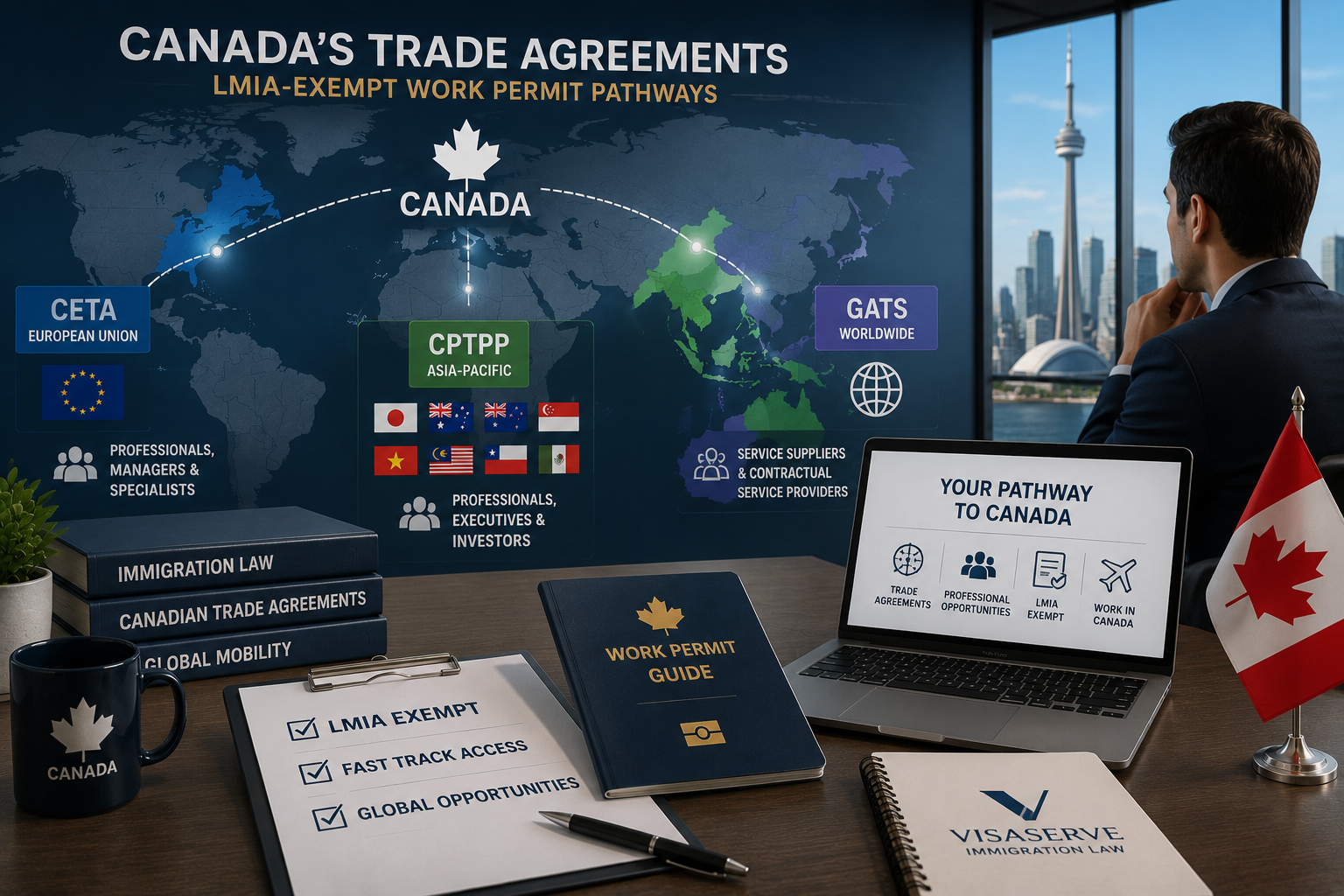
CUSMA gets most of the attention when people talk about trade agreement work permits, and for good reason since it covers the busiest cross-border corridor in the world. But Canada has signed 15 free trade agreements spanning more than 50 countries, and several of them offer the same kind of LMIA-exempt fast track for workers who aren’t American or Mexican citizens.
For European Union citizens, CETA, the Comprehensive Economic and Trade Agreement, mirrors much of what CUSMA offers. It’s especially useful for independent contractors, engineers, and scientific consultants coming to Canada to complete short-term service contracts, letting them skip the standard labour market test entirely.
The CPTPP, or Comprehensive and Progressive Agreement for Trans-Pacific Partnership, connects Canada to a wider group of Asia-Pacific economies, including Japan, Australia, New Zealand, Singapore, and the United Kingdom following its recent addition. Skilled technicians, executives, and professionals from member countries can use this agreement to enter the Canadian labour market without needing an LMIA.
Then there’s GATS, the General Agreement on Trade in Services, which is administered through the World Trade Organization and applies more broadly across member countries worldwide. Updated IRCC guidance from earlier this year clarified how GATS professionals can enter Canada for short-term contracts of up to 90 days within a 12-month period, again without a labour market test standing in the way.
Across all of these agreements, the same three general categories tend to show up. Professionals and technicians need a pre-arranged job offer or service contract with a Canadian client, in an occupation that matches what the treaty text specifies, along with the right educational background or licensing. Intra-company transferees can move within a multinational company to its Canadian branch, provided they’ve worked for the foreign office for at least a year in a managerial, executive, or specialized role. Traders and investors round things out, covering people conducting substantial trade with Canada or putting real capital into a Canadian business.
The application process runs similarly no matter which agreement applies. The employer submits the job details and pays the $230 compliance fee through the IRCC Employer Portal, generating an Offer of Employment number, and the worker then applies for the permit using that number and supporting documents tying their credentials to the treaty’s requirements.
Just like with CUSMA, spouses and common-law partners of workers under these agreements can apply for their own open work permit, and time spent working in Canada under any of these treaties can help build a stronger Express Entry or Provincial Nominee Program profile.
FAQs
Do CETA, CPTPP, and GATS work permits require an LMIA?
No. Like CUSMA, all three are LMIA-exempt for qualifying applicants.
Who can use the CETA work permit pathway?
Citizens of European Union member states, particularly independent contractors and professionals on short-term service contracts.
How long can a GATS work permit last?
Generally up to 90 days within any 12-month period, per current IRCC guidance.
Can spouses of CETA, CPTPP, or GATS workers work in Canada too?
Yes, spouses and common-law partners are generally eligible for an open work permit.
Is one of these agreements faster than the others?
Processing generally follows the same framework, though CUSMA remains unique in allowing U.S. citizens to apply directly at the border.
Reach out to our team at info@visaserve.ca or call 905-203-2266 to speak with an experienced Canadian immigration lawyer today.